

Artists certificate of authenticity. Printable Certificate of Authenticity Template for Artwork
What a Professional COA Should Include
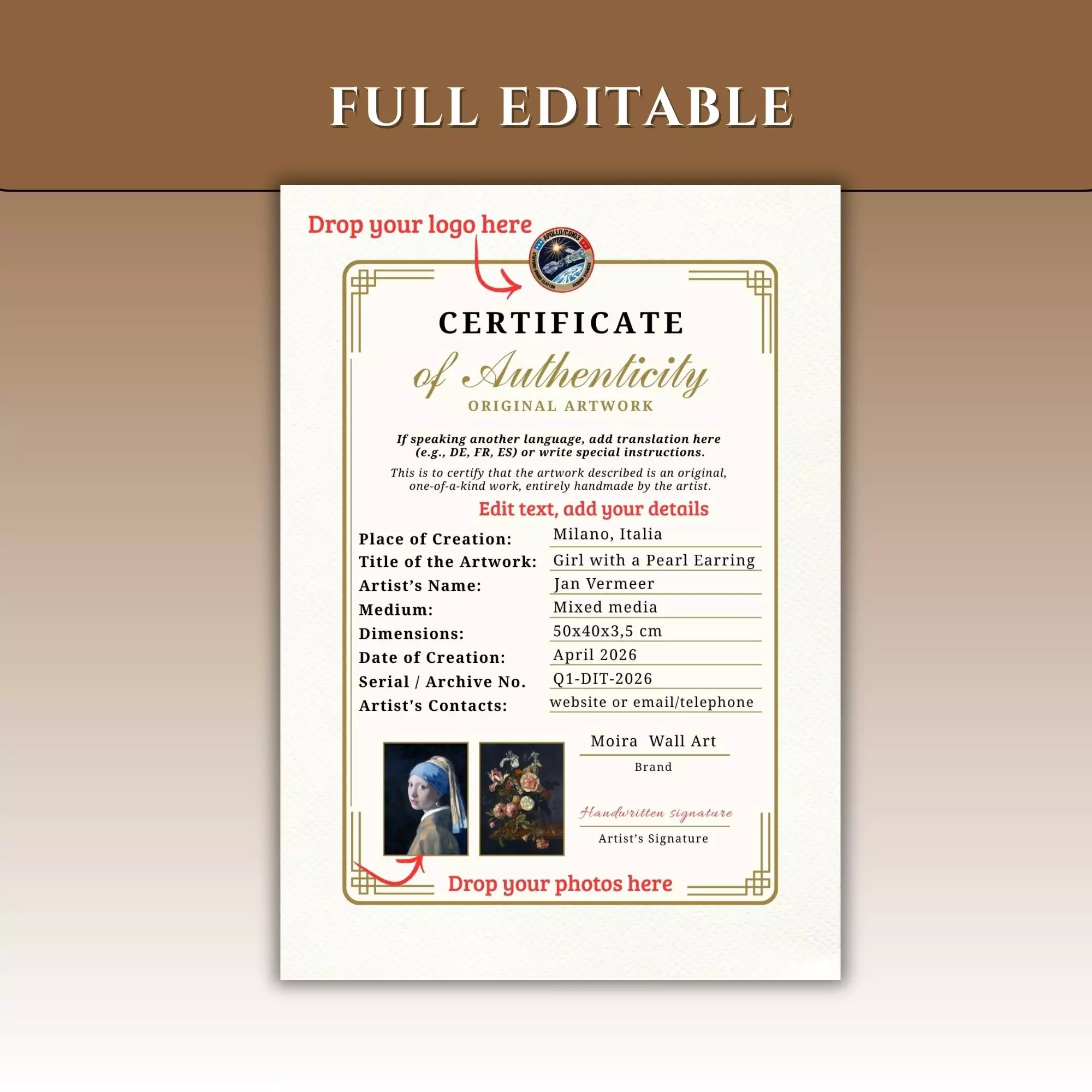
Not all certificates are created equal. A credible Certificate of Authenticity for artwork should contain at minimum:
- Artist’s full name
- Title of the artwork
- Medium and materials used (e.g. acrylic and gold leaf on canvas)
- Dimensions (in both cm and inches for international buyers)
- Date or period of creation
- Edition or serial number (especially important for limited editions and prints)
- A photo of the artwork — this is what truly ties the document to the specific piece
- Artist’s signature
- Contact information or logo
- An authentication statement confirming the work is original and handmade
The format matters too. The industry standard used by most galleries is A5 (14.8 × 21 cm / 5.8 × 8.3 inches) — large enough to look official, compact enough to fit in an envelope or attach to the back of a canvas without folding. Print it on cardstock of at least 250–300 gsm to give it the weight and feel of a real document.
The Solution: A Ready-to-Edit COA Template on Canva
This is exactly why I created a complete Certificate of Authenticity bundle for artists — a professionally designed, fully editable template available on Etsy as an instant digital download.
No design skills needed. No Canva subscription required. Just your artwork details and five minutes of your time.
What the bundle includes:
- ✔ Three artwork shape versions — rectangle, square, and round — so the photo placeholder always fits your actual piece perfectly
- ✔ Editable Canva template — change colors, fonts, logo, signature, and every field to match your brand
- ✔ A5 format (14.8 × 21 cm / 5.8 × 8.3 in) — the gallery-standard size, ready to print at home or at any local print shop
- ✔ Print-ready PDF — download as PDF, PNG, or JPG the moment you are done editing
- ✔ Instant digital download — access your files immediately after purchase, directly from your Etsy account
Whether you are a painter, illustrator, photographer, sculptor, or mixed-media artist, this template adapts to your work and your identity as an artist.
🎨 Professional Certificate of Authenticity for Artists!
Want to give your artwork a professional, gallery-worthy presentation?
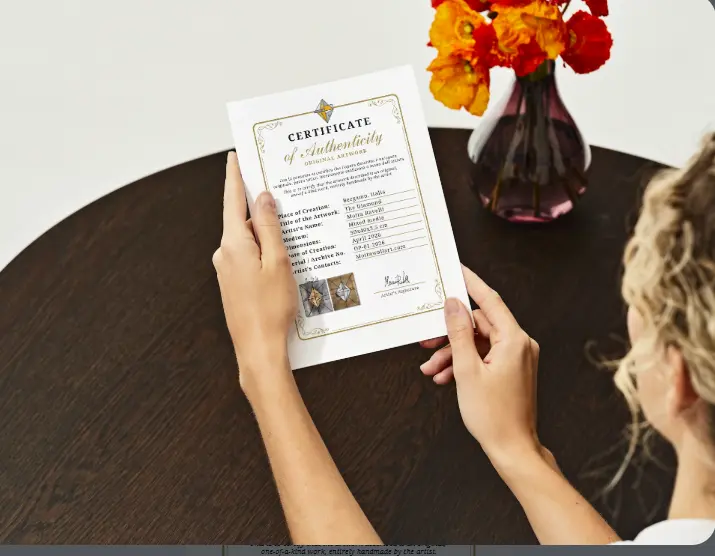
Download my editable COA template, customize it in Canva in minutes and print it on heavy cardstock. Three artwork shape versions included — rectangle, square and round.
- ✅ Instant download – start customizing immediately after purchase
- ✅ Canva Free – no paid subscription required
- ✅ Unlimited use – one purchase, certificates for every artwork you sell
🖼️ PERFECT FOR:
Original paintings • Limited editions • Handmade artworks • Art commissions
Print at home or send digitally — A5 format, print-ready PDF
What Is a Certificate of Authenticity for Artwork?
A Certificate of Authenticity (COA) for artwork is an official document that confirms an artwork is original, one-of-a-kind, and entirely handmade by the artist. It includes key information such as the artist’s name, the title of the work, the medium used, dimensions, date of creation, and a unique serial or archive number. It is signed by the artist and accompanies the artwork at the time of sale. A COA is considered the standard proof of provenance in galleries, auction houses, and private art sales worldwide.
Why Every Artist Selling Original Work Needs a COA
If you sell original paintings, illustrations, sculptures, or any handmade artwork — whether on Etsy, at fairs, through your website or directly to collectors — a Certificate of Authenticity is no longer optional. It is expected.
Here is why it matters more than most artists realize.
It protects the buyer. A collector purchasing an original piece wants the reassurance that what they are buying is genuinely unique. A signed, dated, numbered certificate gives them exactly that — a document they can keep alongside the artwork for decades, or even pass on.
It protects you as the artist. A COA creates a paper trail linking you to your work. As your career grows and your artwork increases in value, that documentation becomes part of your artistic legacy.
It increases perceived value immediately. A painting presented in a protective sleeve with a beautifully designed COA printed on heavy cardstock feels like a gallery purchase — not an online transaction. That feeling directly influences how much a buyer is willing to pay, and whether they will return for a second piece.
It reduces buyer hesitation. Especially when selling online, where buyers cannot touch or see the work in person, a professional certificate acts as a trust signal. It tells them: this artist is serious, this artwork is real, and this purchase is documented.
The Problem Most Artists Face
You know you need a certificate. You sit down to design one, and suddenly an hour has passed. You are choosing fonts, trying to align text boxes, wondering if the layout looks professional enough, second-guessing every field.
Or worse — you send your artwork out with a plain printed page that looks like it was typed in a hurry. The buyer notices. The gallery notices.
The presentation of your artwork does not end with the painting. It ends with the unboxing experience — and the certificate is part of that experience.
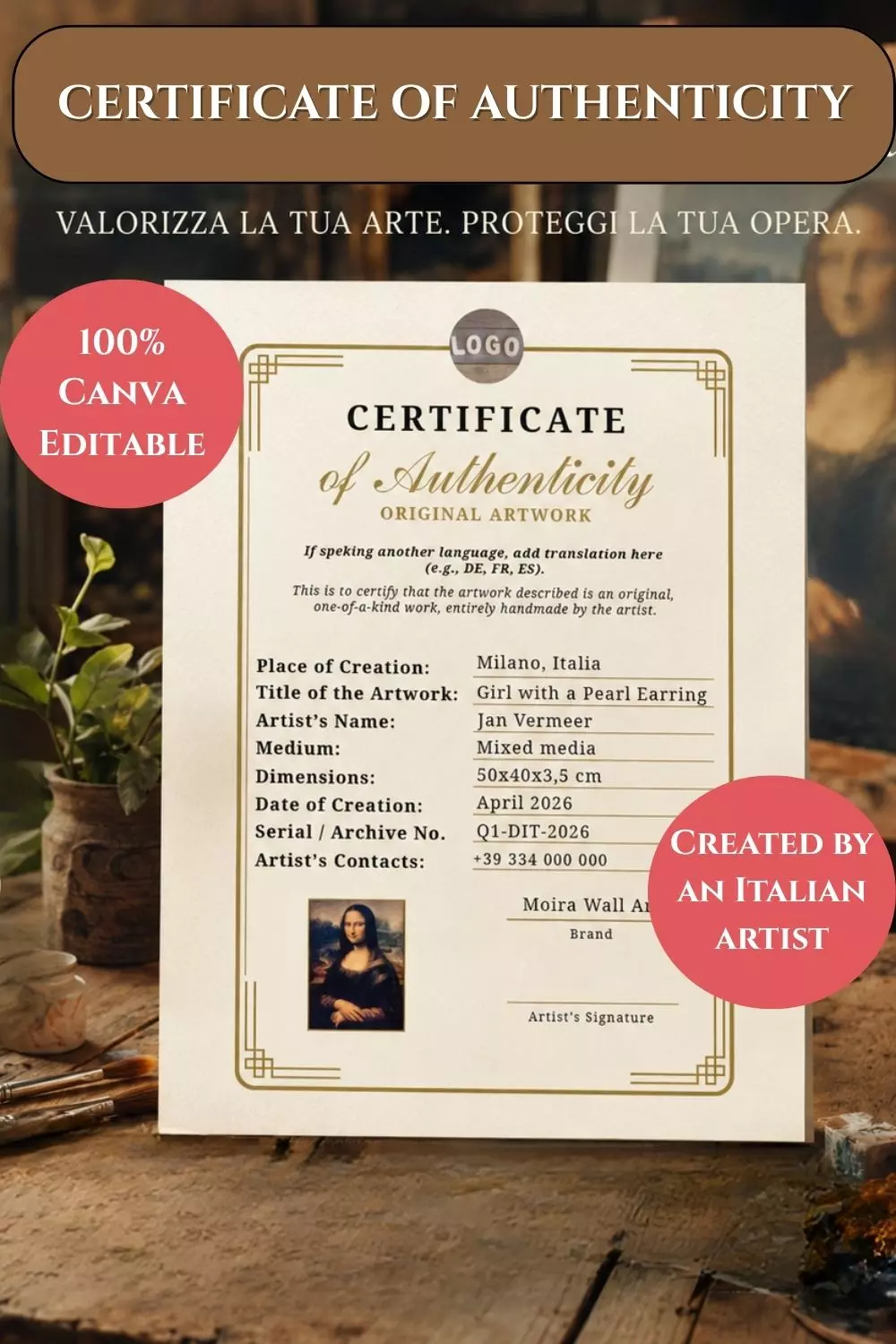
You can personalize:
- Your artist logo
- Your signature
- Your brand colors
- Every artwork detail, edition number, and creation date
- A personal note or authentication statement in your own voice
And because it lives in Canva, you can reuse it endlessly — one purchase, unlimited certificates, for every artwork you will ever sell.
👉 Get the Certificate of Authenticity Template Bundle on Etsy →
A Note from One Artist to Another
I started taking my COA seriously the day a collector asked me — mid-conversation, completely casually — “Does it come with a certificate?”
I had been selling original paintings for a while at that point. I knew my work was good. But in that moment I realized that what the buyer was really asking was: Can I trust this? Is this real? Will this hold its value?
The certificate was never really about paperwork. It was about trust.
I am Italian, and in Italy we have a deep cultural relationship with art, with provenance, with the idea that a work of art carries a story that belongs not just to the artist but to everyone who will ever own it. A certificate is how that story survives the sale.
I designed this template the way I would want to receive one — elegant, clear, and substantial enough to feel like it belongs alongside the artwork it accompanies. Because it does.
If you are an artist putting your work into the world, you deserve documentation that matches the quality of what you create.
A Certificate of Authenticity is not always legally required, but it is strongly recommended when selling original artwork. It provides proof of authenticity, reassures buyers, and adds a professional touch to every sale.
The A5 format (5.8 × 8.3 inches / 14.8 × 21 cm) is one of the most popular choices. It is elegant, practical, easy to store, and widely used by artists, galleries, and collectors.
A Certificate of Authenticity does not determine the monetary value of an artwork by itself. However, it enhances the artwork’s credibility, demonstrates professionalism, and provides documented provenance, all of which can increase buyer confidence and the perceived value of the piece.
Your artwork tells a story. Make sure the paperwork does too.
👉 Download the Editable COA Bundle for Artists on Etsy →
Instant download · Canva Free · A5 format · 3 artwork shape versions included